
Maui homes For Sale
- Haiku Homes For Sale
- Haliimaile Homes For Sale
- Hana Homes For Sale
- Honokowai Homes For Sale
- Kaanapali Homes For Sale
- Kahakuloa Homes For Sale
- Kahana Homes For Sale
- Kahului Homes For Sale
- Kanaio Homes For Sale
- Kapalua Homes For Sale
- Kaupo Homes For Sale
- Keanae Homes For Sale
- Keokea Homes For Sale
- Kihei Homes For Sale
- Kipahulu Homes For Sale
- Kuau Homes For Sale
- Kula Homes For Sale
- Lahaina Homes For Sale
- Lanai Homes For Sale
- Launiupoko Homes For Sale
- Makena Homes For Sale
- Maalaea Homes For Sale
- Makawao Homes For Sale
- Maui Meadows Homes For Sale
- Molokai Homes For Sale
- Nahiku Homes For Sale
- Napili Homes For Sale
- Olinda Homes For Sale
- Olowalu Homes For Sale
- Paia Homes For Sale
- Pukalani Homes For Sale
- Spreckelsville Homes For Sale
- Ulupalakua Homes For Sale
- Wailea Homes For Sale
- Waihee Homes For Sale
- Wailuku Homes For Sale
One of the Oldest Iiwi Ever Discovered and Re Released on Big Island
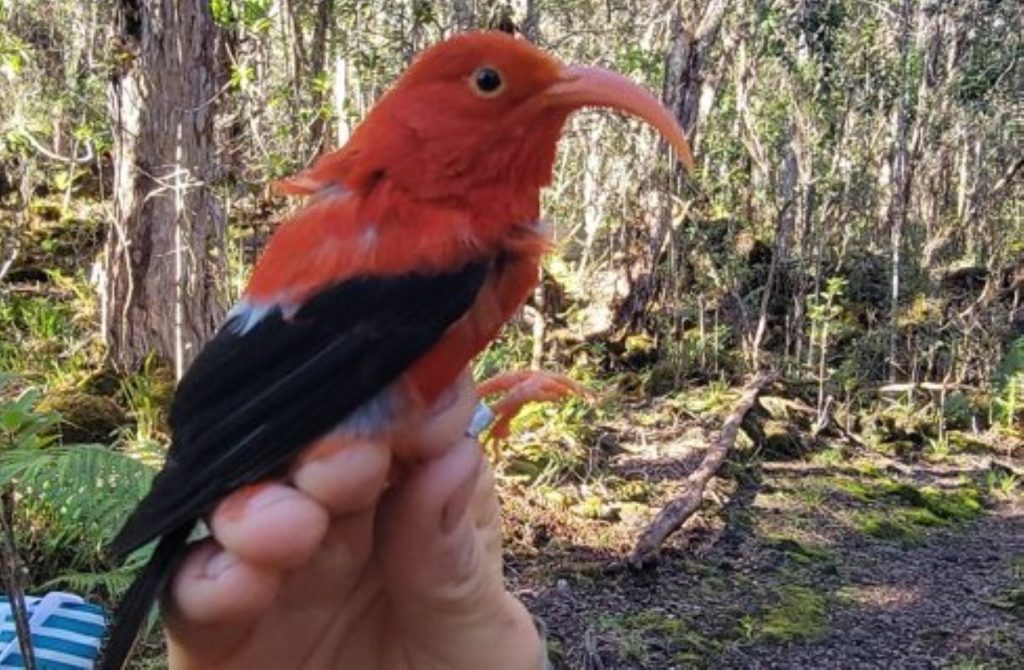
A remarkable forest bird kupuna is once again flying free in the high elevation forests of Hawaiʻi Island.
Staff from the Hawaiʻi Department of Land and Natural Resources Division of Forestry and Wildlife recently recaptured and re released one of the oldest iiwi ever observed in the wild.
The vibrant Hawaiian honeycreeper likely hatched during the winter or spring of 2015 to 2016, making him at least 10 years old. That is an extraordinary milestone for a species whose typical lifespan is estimated at just three to five years.
A Decade Old Forest Survivor
The male iiwi was originally banded in 2018, at least in his second year of life, by researchers from the University of Hawaiʻi at Hilo. In January, Division of Forestry and Wildlife staff recaptured him in the same Upper Waiakea Forest Reserve area where he was first studied.
Identified by his unique leg band combination white white orange aluminum, the bird may still be spotted along the Na Ala Hele Puu Oo Trail in the reserve.
For wildlife biologists, encountering a decade old iiwi in the wild is both rare and encouraging, offering insight into the resilience of a species facing ongoing environmental pressures.
Conservation Status Secure Globally Imperiled Locally
The iiwi is endemic to Hawaiʻi, meaning it is found nowhere else in the world. While NatureServe ranks the species as apparently secure globally, citing its relatively broad range and overall population, the organization notes cause for concern due to local declines and persistent threats.
In fact, NatureServe considers the bird critically imperiled on Oahu and Molokai, and possibly extinct on Lanai.
The International Union for Conservation of Nature also lists the iiwi as vulnerable on its Red List of Threatened Species.
Within the state of Hawaiʻi, the bird is classified as endangered on Oahu, Molokai and Lanai.
A Jewel of the Hawaiian Forest
According to the Division of Forestry and Wildlife, the iiwi is one of the most beautiful of the extant Hawaiian honeycreepers. Both males and females display brilliant vermilion red plumage, accented by black wings and tail feathers and a long, decurved pink bill perfectly adapted for feeding on nectar.
Historically, Native Hawaiians used hundreds of thousands of iiwi feathers to craft feather capes, symbols of power and prestige reserved for high ranking alii. The bird’s cultural importance is matched by its ecological role.
Like the apapane, iiwi often travel long distances in search of blooming ohia trees and serve as important pollinators.
Habitat and Diet
Today, iiwi are most commonly found above 4100 feet in elevation on Hawaiʻi Island, Maui and Kauai, with smaller relict populations on Oahu and Molokai. They were once widespread at lower elevations across all the main Hawaiian Islands.
These honeycreepers thrive in mesic and wet forests dominated by ohia and koa. High density areas also support kolea, naio and hapuu tree ferns, while mamane is common in high elevation foraging zones.
Their diet consists primarily of nectar from both native and non native flowers. The presence of non native flowering plants may have contributed to localized population increases. Iiwi also supplement their diet with small arthropods.
Ongoing Threats
Despite some stable populations on Hawaiʻi Island and Maui, the species remains vulnerable to a range of threats. Habitat loss and degradation continue to challenge forest ecosystems. Predation by introduced mammals further pressures native bird populations.
One of the most significant limiting factors is avian malaria, spread by cold intolerant Culex mosquitoes. Because these mosquitoes thrive at lower elevations, most iiwi are now largely restricted to higher, cooler forests above 4100 feet.
Although much of the species current habitat falls under state or federal management, the quality of protection and restoration efforts varies considerably.
A Symbol of Hope
The recapture and release of this 10 year old iiwi is more than a feel good wildlife story. It highlights the importance of long term monitoring, habitat protection and continued conservation investment.
In a landscape where many native Hawaiian forest birds face steep declines, this resilient survivor stands as a living testament to both the fragility and endurance of Hawaiʻi unique ecosystems.